
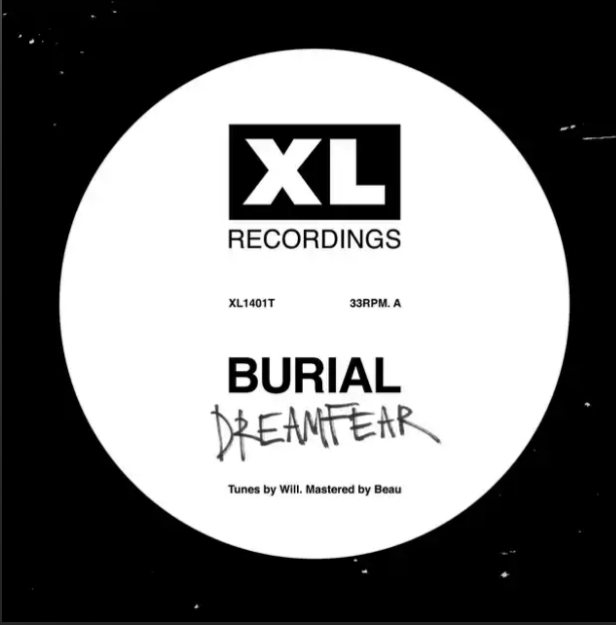
In the weeks leading up to Dreamfear / Boy Sent From Above, the initial spark of excitement that burns in anticipation of new material from Burial dimmed – an announcement of its release on XL as opposed to Hyperdub disappointed those to whom the aesthetic sensibilities of Hyperdub, or certainly their memories of Hyperdub fifteen years ago, are inextricably linked to Burial’s output. That it released in a year celebrating two decades of Hyperdub and had little immediate sonic connection to both the label and Burial’s most acclaimed work soured some further. Reacting to leaks and teasers, interspersed with more optimistic opinions were those that opined it’s apparent laziness. I remember reading someone say “If this had been released by someone unknown on soundcloud, no one would care.” That this is true of all music is a fact that probably avoided them.
For many casual listeners it’s easy to feel lethargic and unimpressed by the single. Burial’s direction in the 2020s has been a personal favourite of mine – music that occupies that same spirit of his debut and Untrue while being weightless and unanchored to musical tropes.
Dreamfears is anachronistic in this regard – the signature vinyl warmth and crackle of Burial’s older material feels here closer to self parody. Dreamfear’s central beat arrives without aplomb, and is looped in a way which seems to strip it of context, as if its missing large parts. Its more pronounced 90s hardcore influence seems at odds with this production choice, where the music seems to be gated at higher intensity, cutting itself off at points like an awkwardly intersecting conversation at a party. Its hardcore influence feels therefore muted, like it’s the faded memory of hardcore. The sound of comments on acid house compilation youtube uploads. The sound of nostalgic memory porn for past-its. Less “london-after-the-rave” and more “life-after-dance”.
Burial here sounds like an alien attempting to recreate dance music based on a second-hand description, making something that seems to have its own set of values and priorities – completely divorced from original context and conventional taste. Vocal samples are warped and soured, the minimal soulful choices of the past abandoned in favour of elongated and cumbersomeones. The skittish sounds of “Back from the dead, fucked up in the head” seems a world’s apart from even the later tracks on Tunes 2011-2019.
Boy Sent From Above more directly evokes an almost liturgical sound, feeling directly analogous to the subtle spiritual undertones of Antidawn and Streetlands. Whereas those two releases felt like the respite of a street chapel’s ambience, Boy Sent From Above feels like the late-night streets surrounding the chapel. It’s hard for the title not to evoke Christ in some respect, but also connects the track to the alien production sensibilities of Dreamfear.
Burial occupies an odd space in electronic music – both media promotion and streaming algorithms depict him as being disconnected from his genre contemporaries. The average Burial fan is likely to be more familiar with Radiohead than they are Todd Edwards, which colours the reception of a lot of Burial’s material – in my mind this results in records like Rodent and Dreamfear receiving a more sour reception. Burial explicitly choosing to draw from older, less fashionable choices was always going to alienate some, but this imbues the record with a reflective energy.
Reading Knausgård again recently put me in a pensive, reflective mindset of my own that accentuates my love for Dreamfear. It feels stupid in a lot of ways, I’m still young – marginally, at any rate – I’m at a point in my life that I will pine for in a decade, and all I worry about is getting older, about reflecting, about fading away, about disintegration. Knausgård is compared to Proust a lot, naturally, but Proust to my mind is so much more concerned with deconstructing the past to build an image of the future. Knausgård’s work feels to me so exhaustively entrenched in the past that there’s barely a present, and little hope of a future – though in spite of this he never feels cynical or bitter to my mind. Knausgard too, feels old beyond his years – despite his countenance and demeanour, he was only 40-odd when A Death In The Family was published.
Burial seems to sit in the middle, harmonising the past and future to make music that feels distinctly modern, distinctly now. Music that seems prescient in spirit but speaks to 2024 whether it wants to hear or not.
As I write this, Intention by Acopia plays on shuffle, or more accurately that algorithmic pseudo-shuffle that occurs after a record finishes and you haven’t set it to repeat itself. The intention-impression-exception-redemption rhyme is pleasing, and the track soothing for a day spent rehabilitating an injured pec. Their name fascinates me, sounds familiar. Google its meaning, find a Physiopedia entry defining Acopia as a “patients inability to cope with activities of daily living.” I won’t try to think about the implications of this, and won’t chalk it up to providence, and stop writing. Oneohtrix Point Never plays, then Clark.
 HypIreStition Ruins
Leave a comment